
 0
0
 0
0
Imagine not being able to say “I love you,” crack a joke, or even ask for help – not because you don’t want to, but because your brain won’t let you.
For many people with neurological conditions like ALS (Amyotrophic Lateral Sclerosis), that’s not a hypothetical – it’s everyday life. Until recently, their best option was to slowly tap out words with their eyes or use a computerized voice synthesizer that speaks in a robotic monotone.
But that’s all about to change.
In a major scientific breakthrough published last month in Nature (NB that paper is behind a paywall but you can read the pre-print here), researchers have developed a neuroprosthesis that can translate brain activity into real-time, natural-sounding speech. Let that sink in: a person who can no longer speak aloud is now able to communicate with their own synthetic voice, including tone, pitch, emotion — even singing.

Gone are the days when, as in the case of Prof Steven Hawkings (RIP), the artificial voices that were available to people who were unable to speak were monotonic, painstakingly pre-programmed with eye or head movements and entirely artificial sounding. The real-time monitoring of live neural activity in brain areas that actually trigger movement of bodily muscles is getting so fast that science is heading in the direction of speechless people being able to express themselves freely and in their own voice.
It doesn’t work straight away of course. The user needs to practice every day to get the prosthetic to generate the kind of speech that will make dialogue with others more effective, but with hard work and determination it is now possible. Just check out the improvement between day 27 after implantation of the brain chip, when the speech is still pretty incomprehensible:
https://ucdavis.app.box.com/s/p8197z804du92225ff0o06l263tjhxcb
And day 179 when it is halting, due to the huge effort that producing each word is for someone afflicted by ALS, but nonetheless each word is very understandable:
https://ucdavis.box.com/s/esulu85i7meojqnpphr65ioq9pui9xbq
From Brainwaves to Voice
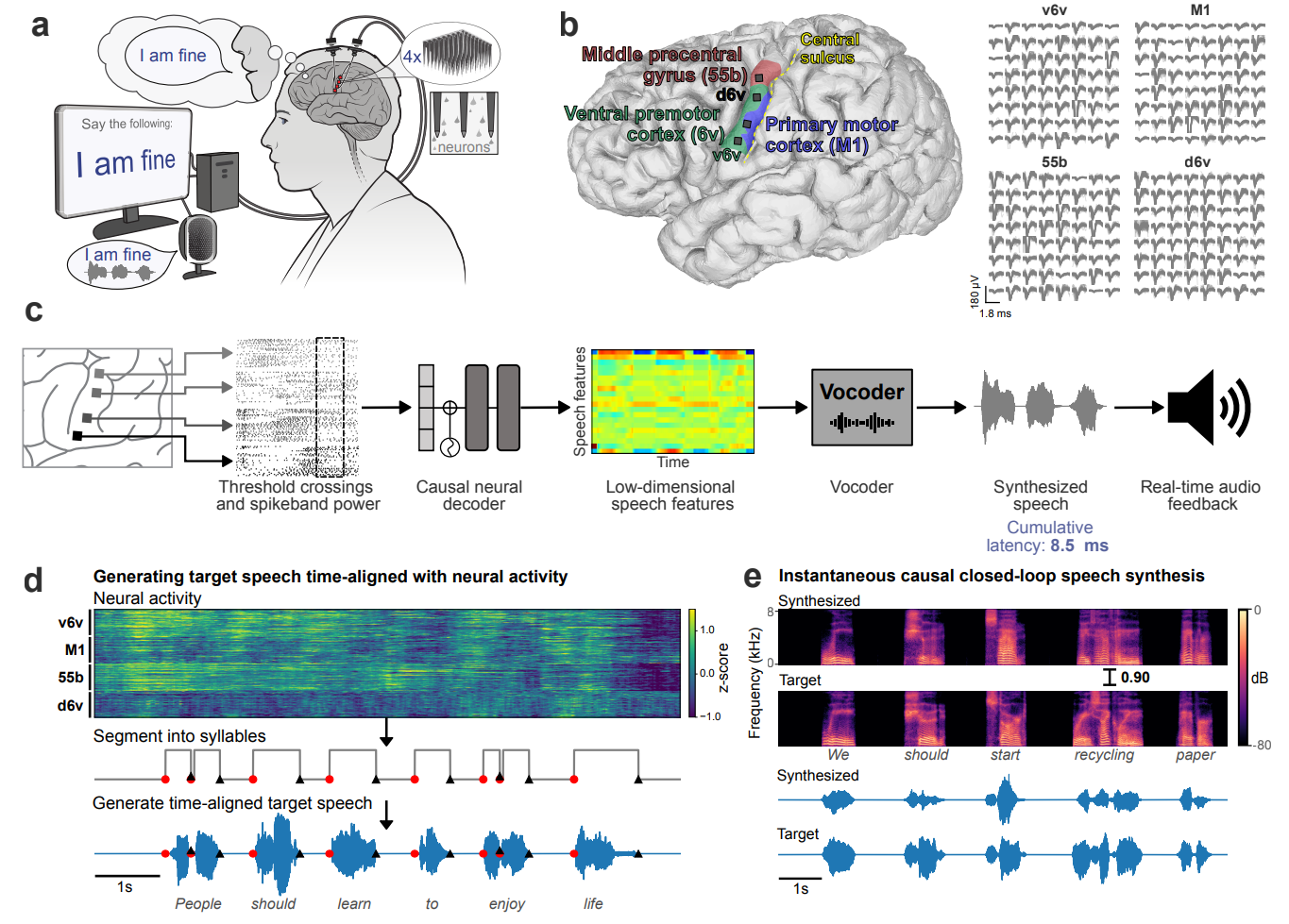
So how did they pull off this impressive piece of work? A team of neuroscientists and engineers, led by researchers at UC Davis and Brown University, worked with the man who features in the above videos (referred to as “T15”) who has ALS which caused him to lose the ability to speak clearly. They implanted tiny electrode arrays into parts of his brain responsible for planning and triggering the muscle movements required to produce normal speech. 256 electrodes in total (4 separate arrays of 8 x 8 electrodes each affixed to a different part of the man’s motor cortex) could then continuously read off the activity of nearby neurons, producing a vast quantity of data that must be crunched at lightening speed.

Then, using deep learning artificial intelligence algorithms, they trained a system to decode the patterns in his brain activity when he attempted to speak. The system then turned those signals into speech — not text on a screen, but actual audible words, complete with rhythm, pitch, and expression. And importantly each part of the sound created almost instantaneously.
It’s not just about the words. It’s about the voice – the sound, the personality, the aural humanity.
Why This Is Such a Big Deal
You might be thinking: haven’t there been speech devices for years? Sure. But here’s the key difference:
Most existing technologies spell out text slowly or convert brain activity into typed words, which are then read aloud by robotic voices. That’s helpful – but it’s far from natural conversation.
This new system bypasses all that. It doesn’t need typing or scrolling or choosing from a menu of pre-set words. It doesn’t even need a pre-built vocabulary. The user just tries to speak – in their head just as they used to before they were robbed of their ability to speak without thinking about it – and the system decodes that intention directly into speech.
Even better, the synthesized voice can reflect the user’s emotions and intentions. Want to ask a question? The system raises the pitch at the end of the sentence. Want to emphasize a word or add a dramatic pause? That’s possible too. The researchers even got T15 to sing using only his brain. Well to be fair, the signing is fairly rudimentary, the system can tell when he is trying to emit a low, medium or high pitched sound and produce something suitable, but it’s a great start and way ahead of previous efforts, This video is from day 342 after brain chip implantation:
https://ucdavis.box.com/s/qu5nwz8qg6hpxtqnvjqkxla1mhoic99c
This is not just about restoring communication – it’s about restoring identity.
A Personalized Voice, Not a Robot
One of the most touching moments from the research? When the team trained the system to replicate T15’s own voice – the way he sounded before ALS stole it from him. Here’s the video from day 286:
https://ucdavis.box.com/s/0vbppq1bevhhblrdfs465fdwuvcn06nd
On hearing it, he later said: “It made me feel happy and it felt like my real voice.”
That’s not just powerful. That’s profound. Voice isn’t just sound — it’s part of who we are. We express ourselves through how we speak, not just what we say. Until now, no technology could give that back to someone who had lost it.
How It Works
As mentioned, researchers implanted four tiny electrode arrays in T15’s brain so that when he tries to speak — even if no sound comes out — it can nonetheless detect the brain signals trying to generate those movements of he lips, tongue and larynx. The system captures them, decodes what he’s trying to say, and synthesizes it into audio using a vocoder powered by artificial intelligence.
Importantly, it does this fast i.e. producing the sound in less than 10 milliseconds after the neuronal activity has been detected. That means T15 hears the synthetic version of his voice as he’s “speaking” – creating a feedback loop that helps make the speech sound more natural and expressive.
It’s basically like giving the brain an alternative mouth so that the desired speech can finally get out into the world.
The Future of Voice Neuroprosthetics
This research is an enormous leap forward, but it’s also a beginning. As the videos provided at the bottom of the paper, showing T15 in action show, there’s still work to do. The system doesn’t every word perfect and it requires an invasive implant. But the path is clear.
Over time, as the technology improves, we could see this kind of brain-to-voice communication become more accurate, more accessible, and more widespread.
Imagine people with ALS, stroke, cerebral palsy or traumatic brain injury regaining their ability to speak in their own voice, in real time, as naturally as breathing.
The team behind this study also believes future versions could support multilingual speakers, include even more expressive control, and eventually work with smaller, less invasive devices.
More Than Medicine – A Matter of Dignity
There’s a difference between communication and connection. It’s one thing to send a message. It’s another to be heard, to be understood, to laugh, sing, ask questions, interrupt, express anger, or whisper a secret.
For people who’ve lost the ability to speak, this technology doesn’t just restore function — it restores freedom. It puts them back into conversations they’ve been left out of for years.
T15’s words in the study say it best: it felt like his real voice.
And when your voice returns – your real voice – so does a part of your self.
In addition to these monthly brain blogs, I’m also active on the social media platform formally known as Twitter (www.x.com/drjacklewis), Instagram (www.instagram.com/drjacklewis_neuro) and LinkedIn (www.linkedin.com/in/drjacklewis).


